

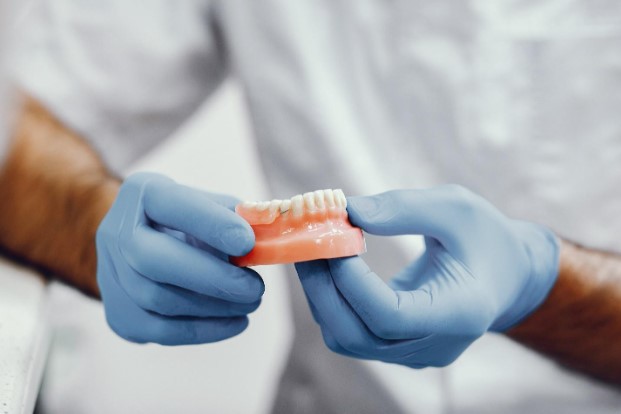
Your smile and general oral health can be significantly impacted by losing one or more teeth. Fortunately, there are efficient ways to replace lost teeth in modern dentistry. Dental bridges are among the most common options.
Dental bridges are implants that fill the space created by missing teeth and offer both practical and cosmetic advantages. We will discuss how dental bridges can improve your smile and promote long-term oral health.
What are Dental Bridges
One or more lost teeth might be replaced with a fixed dental treatment called a dental bridge. By attaching to nearby teeth and inserting a prosthetic tooth for the lost one, it fills the gap. To guarantee that the replacement tooth blends in perfectly with your original teeth, it is made of materials, including metal, porcelain, or ceramic.
Dental bridges offer both practical and cosmetic enhancements and are made to fit your mouth. They offer a long-lasting and affordable alternative, particularly for individuals who are ineligible for implants due to financial or health-related reasons.
How Dental Bridges Can Enhance Your Smile
One of the most visible benefits of dental bridges is the enhancement of your smile. Your confidence and the way your smile looks can be impacted by visible gaps in your mouth caused by missing teeth. By filling in the gaps and restoring an entire set of teeth, dental bridges enhance the appearance of your smile.
Dental bridges are made to precisely match your original teeth in terms of size, form, and color, guaranteeing that the restoration will fit in perfectly with your natural teeth. Dental bridges are a dependable way to achieve a more attractive, well-balanced smile, regardless of how many teeth you are missing.
Improving Oral Health
In modern dentistry, dental bridges are the most effective way to maintain long-term oral health and aesthetics. Food particles and plaque can accumulate in dental gaps if they are not filled, increasing the risk of tooth decay, gum disease, and bone loss. The surrounding teeth may also experience undue stress and wear from compensating for the missing teeth.
By replacing the missing tooth with a dental bridge, you not only stop the surrounding teeth from shifting but also lower the risk of oral health problems that can develop from untreated gaps.
Which Type of Dental Bridge is Right For You
Dental bridges come in a variety of forms, each suitable for specific situations based on your preferences and oral health. Among the most popular types are:
Traditional Bridges: These are the most popular kind of bridges, and they use dental crowns on the adjacent teeth to secure the pontic.
Cantilever Bridges: When there is just one adjacent tooth next to the gap, these are utilized. This one tooth serves as the bridge’s support.
Maryland Bridges: Often used to replace front teeth, and are held up by a porcelain or metal frame that affixes to the back of the neighboring teeth.
Implant-Supported Bridge: This offers the advantages of a fixed bridge without requiring the healthy nearby teeth because it is supported by dental implants rather than natural teeth.
